

Do You Own Large, Concentrated Positions? Don’t Fret! You Have Options.

Written by: Kevin Kern and Kevin Kelly
More and more investors are finding themselves with individual stock positions exceeding $500,000 that represent a significant portion of their overall portfolio. These positions often result from a well-timed investment, years of accumulated employer stock, or an inheritance. While these investments may have performed exceptionally well, such a high level of concentration is often not appropriate as a long-term strategy.
For example, if half of a $4 million portfolio is invested in a single volatile stock that pays no dividend, the investor may have more risk and/or less cash flow than desired. Fortunately, there are strategies that can help address these challenges without requiring an immediate sale of the position.
Option strategies such as collars and covered calls can help investors either reduce downside risk or generate additional cash flow. Like any investment decision, there is no free lunch. Both strategies require giving up some potential upside in exchange for those benefits.
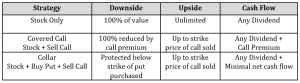
A collar establishes a floor beneath the stock’s value while placing a ceiling on future gains. The investor purchases a put option to protect against a decline in the stock price and helps offset that cost by selling a call option, which limits future appreciation. Typically, negligible funds are generated or utilized to implement the collar.
For investors seeking additional income rather than downside protection, covered calls may be a more appropriate strategy. A covered call allows the investor to receive an upfront option premium in exchange for agreeing to sell the stock at a predetermined price if it rises above that level. The result is additional cash flow, but with limited upside potential. In both strategies, the amount of upside retained will vary based on the stock’s volatility, interest rates, option pricing, and market conditions.
For clients that do not want to limit their upside in a concentrated stock or have concentrated positions that are a smaller percentage of their portfolio, ACM has other tax transition strategies that may be suitable. Additionally, some investors may also choose to use options on only a portion of a concentrated position.
Our goal is simply to help clients understand that they have choices when it comes to managing downside risk, potentially enhancing cash flow, and improving diversification without immediately selling a concentrated position.
Options are simply another planning tool. When used appropriately, they can help solve a common challenge faced by successful investors. We would be happy to discuss whether either strategy fits your circumstances.
Comparing a standalone stock position vs. utilizing a covered call or collar strategy:
Definitions:
A put option is a contract that gives the option holder the right to sell a stock at a specific price within a certain time frame. This specific price is called the “strike price.” If the stock price goes lower than the strike price, then the buyer can exercise the put option to sell the stock at the strike price and benefit from the decrease. 1 Contract = 100 shares
A call option is a contract that gives the option holder the right to buy a stock at a specific price within a certain time frame. This specific price is called the “strike price.” If the stock price goes higher than the strike price, then the buyer can exercise the call option to buy the stock at the strike price and benefit from the increase.
The strike price or “exercise price” is the predetermined price at which the holder of an option can buy or sell the underlying asset.
Advisors Capital Management, LLC is an investment advisor registered with the United States Securities and Exchange Commission. Registration does not imply any degree of skill or training. All investing carries risk, including the potential for the loss of principal and past performance is no guarantee of future results. This content is for informational purposes only, can change at any time without notice, and is not investment advice or a recommendation to trade any security. Indices are not available for direct investment. We only provide services in jurisdictions where we are registered. Our disclosure brochure (ADV Part 2A) and customer relationship summary (ADV Part 3) are available at https://adviserinfo.sec.gov and upon request.


