

Why Is Inflation Stubbornly High?
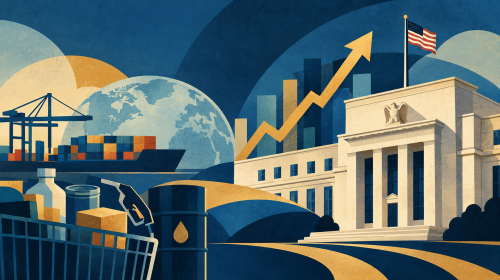
Pressure is mounting on the Fed to hike interest rates to bring inflation back towards its 2% target. There’s a debate whether inflation might recede, as temporary factors boosting inflation dissipate. But many people, including Fed Chairman Warsh and other Fed officials, are getting frustrated with how long this is taking. Our review suggests that the underlying rate of inflation would be close to 2%, if not for exceptional factors that keep it elevated. So, we expect the Fed to hike rates slowly, mostly to signal to investors that its commitment to reducing inflation remains intact, while it waits for the extraordinary factors to weaken.
How Wage Growth and Productivity Affect Inflation
Inflation is driven by both demand and supply factors. On the supply side, the cost of labor is the most critical component of inflation, since labor accounts for a huge fraction of the expense of supplying goods and services. So, it is notable that average wage rates have been rising at a very steady 4% pace for some time and have even moderated a bit over recent months. In fact, we had feared that wage inflation might increase in response to the low rate of unemployment, but that hasn’t happened. It has been remarkably well behaved.
Rising labor costs are partially offset with productivity gains. If productivity were to improve by 4% annually, unit labor costs would be unchanged with wage inflation of 4%. Inflation should then be around zero. Of course, we have almost never seen such a high rate of productivity improvement. But we have averaged slightly more than 2% over the past three years, which implies that underlying price inflation should also be around 2%. Instead, inflation has been stuck in the 3.5% area. So, what accounts for the difference between actual inflation of around 3.5% and the underlying implied 2% reflecting the difference between labor costs and productivity? That difference must be due to short-term unusual factors and we have several candidates: the conflict in the Strait of Hormuz has curtailed oil supplies, tariffs have disrupted trade flows, and a variety of events have disrupted supply chains.
How Oil Prices, Tariffs, and Supply Chain Disruptions Contribute to Inflation
The decline in crude oil supplies is easily seen and measurable at the crude level, but also at the refined level as gasoline, jet or diesel fuel prices. The effects of tariffs and supply chain disruption are far more dispersed throughout the economic system and are consequently much less obvious and extremely hard to unravel from the data. We can see the impact at the very micro level, such as by looking at the effects of tariffs on the price of a single raw material or item, such as aluminum, but that cost increase is less obvious as aluminum is processed into cans or airplanes along with myriad other cost increases elsewhere in the supply or production chain.
Why Temporary Price Increases May Have a Lasting Impact on Inflation Data
These exceptional cost increases are largely one time in nature. The price rise from $60 per barrel to $100 per barrel has a huge impact on all inflation calculations. But unless the price increases again from $100 to $140, that impact will soon dissipate as the first increase gets absorbed into the price structure. (This was precisely the logic behind Chairman Powell first suggesting that the price surge following the Covid shutdown was “transitory”. But the government kept spending money like a drunken sailor, so the price increases took some time to dissipate, although much of the surge did wash out of the data over a few years.)
What Persistent Inflation Could Mean for Federal Reserve Interest Rate Policy
So, what does the still high level of inflation mean for policy? The Fed seems to understand that fundamental underlying inflation should be lower than reported measures, which may be why they are so conflicted about whether they should hike rates. Still, they must show the market they are not indifferent to the high level of reported inflation. So, we expect the Fed to hike rates once this year, likely at the December meeting, so as to avoid becoming a focus of attention prior to the election. Thus, we are in agreement with the market’s pricing. But we are also tracking wage inflation closely, since the low unemployment remains a risk to inflation.
Advisors Capital Management, LLC is an investment advisor registered with the United States Securities and Exchange Commission. Registration does not imply any degree of skill or training. All investing carries risk, including the potential for the loss of principal and past performance is no guarantee of future results. This content is for informational purposes only, can change at any time without notice, and is not investment advice or a recommendation to trade any security. Indices are not available for direct investment. We only provide services in jurisdictions where we are registered. Our disclosure brochure (ADV Part 2A) and customer relationship summary (ADV Part 3) are available at https://adviserinfo.sec.gov and upon request.


