

Planning Opportunities To Consider Before Year-End – Capital Gains

Our year-end planning commentaries typically begin with annual Required Minimum Distributions from retirement accounts, however, we covered this topic at the end of September which you can find by clicking here. For those who are subject to RMDs for their own IRAs or inherited IRAs, then consider this another reminder that they must be completed by year-end (or preferably in advance of year-end).
Year-End Tax Planning: Harvesting Capital Gains and Losses
Separately, there is still time to harvest capital gains and losses before year-end, which is a classic year-end planning technique and one what we employ throughout the year and at year-end for our client’s with private taxable investment accounts.
If you’ve realized significant gains this year, then harvesting unrealized losses (selling stocks that are down and buying them back after 30 days) can lower your modified adjusted gross income (MAGI), which is the basis for how much of your social security is taxed, what your Medicare Part B & Part D premiums will be in 2028, and whether or not your gains will be subject to the additional 3.8% Net Investment Income Tax (NIIT). The NIIT is applied to the portion of your income from investments (capital gains, interest, dividends, rental income, etc.) when your MAGI exceeds $200,000 (filing individually) and $250,000 (filing jointly).
Remember, you normally use capital losses to offset capital gains, but not to offset ordinary income (wages, interest, etc.). You can only apply a limited amount of excess capital losses, up to $3,000, against your ordinary income. You can carryover any unused capital losses you’ve realized from current or prior tax years and apply these against realized gains in future years.
Understanding Wash Sale Rules and Tax-Loss Harvesting
Please also note that, if you sell a stock to harvest the loss, neither you nor your spouse can buy the same stock back in another account or even in a retirement account within the 30-day period. Doing so is known as “wash sale”, which will negate the loss you were attempting to realize. Automatic purchases, contributions, rebalances and dividend reinvestments into a security you harvested a loss from may also inadvertently trigger a wash sale.
Also keep in mind that, if you are counting on receiving a dividend from a stock you own, then you may not want to sell a stock during the period when the dividend is expected to be paid.
It’s a good idea to coordinate the gains/losses realized on your taxable/non-retirement ACM accounts with accounts that you hold elsewhere as well as any other assets you’ve sold this year (residence, business, etc.) and in the event that you own any mutual funds.
How Mutual Fund Capital Gain Distributions May Affect Your Taxes
Mutual fund “capital gain distributions” can be a ‘wildcard’ in projecting your income for the tax year and they can impact your January estimated tax payment as well as your overall taxable income and the Social Security/Medicare surcharge/NIIT items noted above.
If you own any mutual funds that own stocks, then they may have long-term winners on the books as a result of the long bull market. But when volatility causes shareholders to pull their money out, then your mutual fund may have had to sell stocks and realize gains to meet shareholder redemptions. Funds must pass on any long-term and short-term realized gains to shareholders who must pay taxes on them.
Most fund companies have already started to announce their capital gain distribution estimates for 2026, which can be found on their websites in many cases, and the actual payouts will occur from late November until the end of the year.
You have the option to take these distributions in cash or to reinvest them back in to the fund (buy more shares). If you have significant mutual fund positions, then keep in mind that reinvesting the capital gain distributions means that you’ll have to come up with the cash to pay the taxes on these from somewhere else.
2026 Long-Term Capital Gains Tax Rates and the 0% Bracket
Not everyone who has realized gains needs to go through the effort of realizing losses. Single taxpayers, as well as those who are married filing jointly, are eligible to pay 0% on long-term capital gains and dividends depending on their taxable income.
LONG-TERM CAPITAL GAINS RATE
Rates apply to LTCGs and qualified dividends and are based on taxable income.
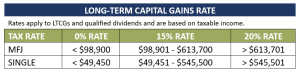
If your taxable income falls into the 0% long-term capital gains bracket, then you may even be in a position to realize more gains rather than worrying about taking any losses.
Additional Capital Gains Considerations: Inheritance and State Taxes
You also don’t want to create more losses than you are able to use during your lifetime as they do not carry over to the next generation. If you planning to leave a stock to someone as an inheritance, then keep in mind that they receive a “step-up in basis” when they inherit the stock and the capital gain can typically be eliminated.
Lastly, keep state income taxes in mind when it comes to capital gains as well. Most states tax capital gains as ordinary income and either limit (or disallow entirely) the ability to carry forward harvested losses into future tax years.
We’ll cover some additional year-end planning ideas over the next few weeks and, as always, please reach out to your ACM Wealth Advisor if you have any questions.
Advisors Capital Management, LLC is an investment advisor registered with the United States Securities and Exchange Commission. Registration does not imply any degree of skill or training. All investing carries risk, including the potential for the loss of principal and past performance is no guarantee of future results. This content is for informational purposes only, can change at any time without notice, and is not investment advice or a recommendation to trade any security. Indices are not available for direct investment. We only provide services in jurisdictions where we are registered. Our disclosure brochure (ADV Part 2A) and customer relationship summary (ADV Part 3) are available at https://adviserinfo.sec.gov and upon request.


