

How Am I Taxed? An Overview of Your Tax Landscape

Now that you’ve endured another tax-filing season, we recognize that a lot of the tax jargon used in this process can be confusing. Most of us just want to understand what we owe and whether some of the financial decisions that were made in the previous year helped or hurt our goal of avoiding unnecessary taxes.
Understanding the nuances of income taxes is crucial for making informed financial decisions. We hope this overview of the different types of income taxes to consider will help provide a clearer understanding of your potential tax obligations.
INCOME TAXES
The U.S. tax system is “progressive” meaning that tax rates increase as income increases.
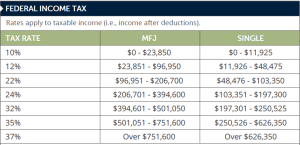
For instance, if you are a married couple with a taxable income of $250,000 for 2025, not every dollar of income is taxed at the 24% rate applied (see below under “MFJ”). Your taxable income has to run through the below series of “tax brackets” to determine what you’ll owe. With $250,000 of income, the first $23,850 of ordinary income is taxed at 10%, then the next $73,099 of is taxed at 12%, then $109,749 at 22%, and the remaining $43,299 at 24%. The total tax for this couple would be $45,693 resulting in an “effective” tax rate of 18.3%.
Each additional dollar of income above $250,000, and up to $394,600, earned by this couple would be taxed at 24% and so 24% is referred to as their “marginal” tax rate.
BONUS INCOME
Bonuses are often misunderstood, with some thinking they are taxed differently. However, bonuses are taxed the same as regular income and taxed in the same way as the scenario above.
WITHHOLDING vs. TAX LIABILITY
It is common for individuals to believe that their employer or IRA custodian withholds the exact amount that they owe in taxes for the year. The reality is that the amount withheld by their employer is based on the information the employee proactively provides. Employers withhold federal income taxes from pay based on the information provided on a completed IRS Form W-4. The W-4 form that you submit tells your employer how much federal tax to withhold from each paycheck. The withholding amount on your W-4 is applied to your regular pay and any bonus you earn.
The process for withholding state income taxes depends on the state. Some states have a state version of Form W-4 that you submit to your employer and some states let the employer calculate an employee’s state income tax withholding based on the information they put on the federal IRS Form W-4.
Federal and state income tax withholdings from IRA distributions are similarly determined by the amounts proactively requested by the IRA account holder. It’s up to the taxpayer to tell the IRA custodian (Fidelity, Schwab, etc.) how much federal and state income tax that they want withheld from each IRA distribution.
We’re pointing out these details because the withholding amounts you proactively provide may or may not accurately reflect your expected tax liability. For those who are unaware, the difference between what is withheld and your actual tax liability can be substantial, resulting in additional tax payments due when you file your tax returns and/or additional/unnecessary penalties for underpayment of income taxes.
Providing accurate information to your employer or IRA custodian is important and projecting your income to determine what to withhold for a given tax year, and the resulting income taxes due, is feasible to do and your ACM Wealth Advisor can help. The same applies to those who are required to make estimated tax payments.
CAPITAL GAINS TAXES
Projecting your salary/bonus and any interest or dividend income that you earn is relatively straightforward and predictable. On a year-to-year basis, the wildcard in projecting your taxable income tends to be realized capital gains.
Capital gains taxes come into play when you make a profit from selling an asset. For example, if you sell an investment for $20,000 that you initially purchased for $10,000, then the $10,000 difference (the “gain”) will be subject to capital gains tax. The capital gains tax rate depends on your income (capital gains tax rates are also progressive) and how long you held the investment.
SHORT-TERM VS LONG-TERM CAPITAL GAINS
Investments held for less than a year and sold for a gain incur short-term capital gains taxes, which align with your marginal income tax rate. For our couple who earned $250,000 for 2024, but also realized an additional short-term capital gain of $10,000, then their $10,000 gain would be taxed at 24% or $2,400 (plus state income taxes). There is no “withholding” that applies to this additional tax liability.
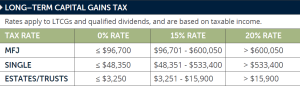
Conversely, investments held for over a year qualify for long-term capital gains rates, which are generally more favorable. “Qualified Dividends” from stocks also qualify for these preferential long-term capital gains rates.
There is no tax withholding applied to long-term capital gains or qualified dividends to help you cover the taxes due on these sources of income. And, if you own mutual funds, then you typically won’t know the long-term or short-term “capital gains distributions” that are made by the fund until late in the tax year (November/December). The lack of withholding and the lack of control/timing of mutual fund distributions makes projecting the dollar amount of these sources of income, and accounting for the tax liability on the same, less straightforward than your salary and bonus where taxes are already being withheld.
NET INVESTMENT INCOME TAX (“NIIT”)
Net Investment Income Tax is an additional 3.8% tax applied to certain to taxpayers with modified adjusted gross income (“MAGI”) over the thresholds noted below. The NIIT obligation is calculated as 3.8% of the lesser of your net investment income or the excess of your modified adjusted gross income over the applicable threshold. Realizing additional income can increase the tax rate applied to your long-term capital gains from 15% to 18.8%, or from 20% to 23.8% so it makes sense to take these thresholds into consideration if when you sell any assets for a gain.

ALTERNATIVE MINIMUM TAX (AMT)
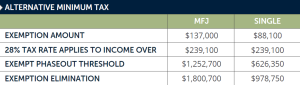
Alternative Minimum Tax (AMT)is designed to ensure that high-income individuals with various tax deductions pay a minimum amount of tax and to ensure that all taxpayers contribute proportionately. It affects a small percentage of households today.
STANDARD DEDUCTION VS. ITEMIZED DEDUCTIONS
Taxpayers always have the choice to either itemize deductions or choose the “standard deduction” to lower their taxable income and the taxes due. Deductions that can be itemized include state and local income taxes (property taxes), mortgage interest, charitable contributions and medical expenses.
The Tax Cuts and Jobs Act (passed in 2017) capped the amount of certain deductions, such as the $10,000 maximum deduction for state and local/property taxes (aka “SALT” cap) and how much mortgage interest you can deduct. At the same time, the TCJA doubled the standard deduction and the result is that, for the past several years, most individual taxpayers had been taking the standard deduction instead of itemizing deductions in order to lower their taxable income.

Taxpayers residing in states with high income tax rates and high property taxes were impacted the most by the $10,000 SALT cap, which has now changed slightly as a result of the One Big Beautiful Bill Act (“OBBBA”) passed in 2025.
The SALT cap is now $40,000 instead of $10,000 for taxpayers with adjusted gross income of $500,000 or less in 2025. The SALT cap phases out with income between $500,000 – $600,000 and is capped back at the lower $10,000 limit for taxpayers with income in excess of $600,000.

Relative to the past several years, more taxpayers with income up to $500,000 – $600,000 (particularly those in states with high property and taxes and state income tax rates) may find themselves itemizing deductions again in 2025 as a result of the OBBBA.
Understanding your tax obligations is fundamental to making sound financial decisions. In providing this overview, we hope to educate our clients with some knowledge and insight in order to put context into some of the tax planning advice you may receive from ACM over the course of 2026. If you have any questions or want to discuss how this information relates to your personal financial plan, please reach out to your ACM Wealth Advisor.
Advisors Capital Management, LLC is an investment advisor registered with the United States Securities and Exchange Commission. Registration does not imply any degree of skill or training. All investing carries risk, including the potential for the loss of principal and past performance is no guarantee of future results. This content is for informational purposes only, can change at any time without notice, and is not investment advice or a recommendation to trade any security. Indices are not available for direct investment. We only provide services in jurisdictions where we are registered. Our disclosure brochure (ADV Part 2A) and customer relationship summary (ADV Part 3) are available at https://adviserinfo.sec.gov and upon request.


