

Federal tax brackets announced for 2027

Figuring out how much you owe for taxes can be complex and sometimes takes some work. That’s because the federal government and the Internal Revenue Service (IRS) don’t assess the same amount of tax for every dollar you earn. Instead, the IRS assigns your income to brackets with tax rates that increase as you earn more money.
2027 Federal Income Tax Brackets and Rates
The US has a progressive tax system at the federal level with seven brackets. The federal income tax rates that apply for individuals (10%, 12%, 22%, 24%, 32%, 35% & 37%) and won’t change next year, but the income tax “brackets” for individual taxpayers will increase by about 3.2% based on inflation.
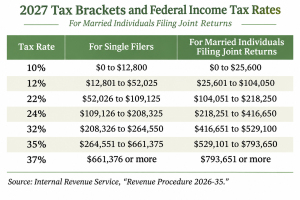
As has been the case for the past several years, this means that you can earn more income in 2027 vs. 2026 before being taxed in a higher tax bracket at a higher rate.
Understanding Marginal vs. Effective Tax Rates
Note that the top tax rate that your income falls into is not the actual rate you pay. The lowest rate of 10% applies to single filers on the first $12,800 or less that they make and married filers making $25,600 or less. As you earn more money, your additional income jumps to the next higher tax bracket and that portion of your income is taxed at a higher tax rate.
For example, a hypothetical single filer would owe 10% or $1,280 on the first $12,800 of taxable income in 2027 whether that amount represents their total earnings, or they earn $1 million. The excess over $12,800 is taxed at 12% up to $52,025, which equates to an additional $4,710. The tax rates continue to increase as someone’s income moves into higher brackets. At the high end, you’ll need to make $661,376 or more filing singly or $793,651 filing jointly before you hit the top 37% rate.
The top rate that you are taxed in is considered your “marginal tax rate” (37% in the case of someone make $1 million or 22% for someone who made $100,000) and the total tax that you pay as a percentage of your income is called your “effective tax rate”.
2027 Standard Deduction and Taxable Income
Before you apply the above income tax rates to your income, you can subtract 401(k) or HSA contributions and either the standard deduction or itemized deductions if you plan to itemize to your total income in order to lower the amount subject to income tax.
For 2027, the standard deduction will be $16,600 for single filers and $33,200 for joint filers.
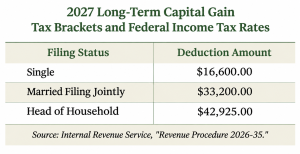
After applying your deduction(s), the difference is your total “taxable income”, although other adjustments to income or deductions may apply.
Changes to the State and Local Tax (SALT) Deduction for 2027
Most taxpayers used the standard deduction versus itemizing deductions while the TCJA capped the deduction for state and local income taxes (SALT) at $10,000 for single and joint filers.
The SALT cap was increased to $40,000 under OBBBA last year, which allowed more taxpayers to itemize deductions again. The SALT deduction increases to $40,804 for 2027 and will continue to increase each year through 2029 and then it will revert to back $10,000 in 2030 pending any new legislation.
The higher SALT limit also begins to phase out, however, when a taxpayer’s modified adjusted gross income exceeds $510,050 in 2027 and reduces the cap all the way back to $10,000 once income exceeds $612,000 (the exact top of the phase-out hasn’t been released by the IRS as of this commentary).
2027 Long-Term Capital Gains Tax Rates and Brackets
Also note that not all income is taxed the same. The above brackets apply to income you’ve earned such as salary, bonuses, tips, interest earnings and withdrawals from retirement accounts such as IRAs.
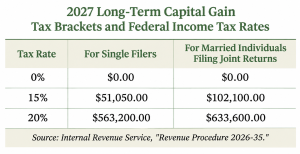
Qualified dividend income and gains that you realize from selling assets that you’ve held for more than one year are taxed separately at the rates and brackets noted below.
You can even qualify for a 0% tax rate on long-term realized capital gains if you earn $51,050 or less filing singly and $102,100 filing jointly.
2027 Gift and Estate Tax Exemptions
Lastly, the first $20,000 of gifts that you make to any person is excluded from tax in 2027 and the lifetime estate tax exemption permanent is raised to $15,480,000 per person. This means that, for a married couple, your combined estate needs to be worth at least $30 million before federal estate taxes apply.
Year-End Tax Planning Considerations
With the tax year starting to wind down, we’ll be starting to highlight year-end tax strategies in our commentaries like tax-loss harvesting, charitable contributions and gifting and Roth conversions.
It’s always a good idea to be having a conversation about tax planning with your ACM Wealth Advisor and you should be on the lookout for our upcoming series of year-end planning commentaries, which we’ll be starting over the next few weeks.
Advisors Capital Management, LLC is an investment advisor registered with the United States Securities and Exchange Commission. Registration does not imply any degree of skill or training. All investing carries risk, including the potential for the loss of principal and past performance is no guarantee of future results. This content is for informational purposes only, can change at any time without notice, and is not investment advice or a recommendation to trade any security. Indices are not available for direct investment. We only provide services in jurisdictions where we are registered. Our disclosure brochure (ADV Part 2A) and customer relationship summary (ADV Part 3) are available at https://adviserinfo.sec.gov and upon request.


