

Droning On: Diversification and Drones

Buying the S&P 500 Index may no longer be the diversified investment many investors once thought it to be. Today, the ten largest companies in the index account for roughly 40% of its weighting. Should SpaceX, Anthropic, and OpenAI be added later this year, that concentration could rise to 50%. When investors purchase an S&P 500 index fund, they often believe they are diversified, but in reality a relatively small number of giant companies now dominate the index.
You might ask, “Well, what’s wrong with having a baker’s dozen of the biggest and best companies dominating my investment?” The problem is that this level of concentration can limit exposure to future opportunity. Diversification does more than reduce risk—it allows investors to participate in the next generation of companies that reshape industries and create enormous shareholder wealth.
However, making sure you own those companies is not easy. A landmark study in 2018 examined more than 26,000 U.S. publicly traded companies from 1926 through 2019*. The results were eye-opening: only about 4% of stocks created all of the market’s wealth over that period. The remaining 96% collectively matched Treasury-bill returns, and nearly 60% of stocks failed to outperform Treasury bills.
The challenge for investors becomes clear. No one knows in advance which small group of companies will become the next major disruptors and wealth creators. Diversification helps ensure that when those companies emerge, investors have a better chance of already having exposure to them.
Looking back over the past several decades, many companies that ultimately transformed industries did not look obvious in their early years. Some were small, unproven, or operating in entirely new markets. Would you have placed 2% of your portfolio into Amazon in 1997? It sold only books on a new and unproven online platform, generated just $15 million in revenue, and lost money. Who would have guessed it would become the disruptor it is today?
Speaking of Disruptors
Global conflicts have provided new insight into the disruption drones have made on the battlefield. In 2018, we purchased a small allocation of a drone manufacturer for our growth portfolio. To say that this holding flew under the radar for some time is not an exaggeration. However, our commitment was strong. Our military advisor in 2017, coming off a recent war game, told our investment team: “Drones will change everything we understand about war. Do some research.”
Curiosity got the better of me this past weekend. The wars in Ukraine and Iran have shown million-dollar missiles chasing swarms of $30,000 drones. The math has begun to make conventional weapons systems too expensive. In many ways, the battlefield has flip-flopped. I was curious to see how our drone holding was performing compared with the well-known Magnificent Seven technology companies over the past two years.
Our drone holding has been Kratos Defense & Security Solutions (KTOS), a defense technology company focused on unmanned systems and advanced military technologies. Over the two-year period ending March 13, 2026, Kratos delivered a cumulative gross return of roughly 392%, outperforming each of the Magnificent Seven over the same timeframe.
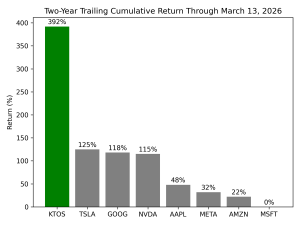
Source: Bloomberg. Two-Year Trailing Cumulative Return Through March 13, 2026
My curiosity of drones is not to highlight Kratos. The above small window of reporting does not represent a long-term trend. Any sign of peace could certainly cool down defense stock expectations. For years, Kratos underperformed these titans, particularly during the COVID years of highly accommodative fiscal and monetary policy when stay-at-home technology companies thrived.
More importantly, the Kratos example is to highlight that diversification provides opportunities. And that within a diversified portfolio, there are times when the predictable companies do the heavy lifting, and times when other companies that have been “flying under the radar” can provide some additional lift or defense.
In investing, the challenge is not recognizing great companies after they succeed—it is owning them before anyone knows which ones they will be. Diversification helps provide the possibility that when those rare companies emerge, our clients might already have a seat at the table.
*“Wealth Creation in the U.S. Public Stock Markets 1926–2019,” published in The Journal of Investing (2021). Hendrik (Hank) Bessembinder, Professor of Finance, Arizona State University.
Advisors Capital Management, LLC is an investment advisor registered with the United States Securities and Exchange Commission. Registration does not imply any degree of skill or training. All investing carries risk, including the potential for the loss of principal and past performance is no guarantee of future results. This content is for informational purposes only, can change at any time without notice, and is not investment advice or a recommendation to trade any security. Indices are not available for direct investment. We only provide services in jurisdictions where we are registered. Our disclosure brochure (ADV Part 2A) and customer relationship summary (ADV Part 3) are available at https://adviserinfo.sec.gov and upon request.


