

How Two Latin Terms Can Impact Your Estate Plan
Key Takeaways
- Per stirpes vs. per capita matters: With per stirpes, a deceased beneficiary’s share of an IRA passes to their children; with per capita, that share is redistributed among the remaining living beneficiaries.
- Beneficiary designations control outcomes: IRA assets pass based on the beneficiary form on file—not your will—making this distinction especially important in retirement and estate planning.

Why Beneficiary Designations Matter in Estate Planning
When we think of estate planning, our focus often turns to a will, trust, Power of Attorney, Health Care Proxy or a Medical Directive. One of the most neglected documents is the Beneficiary Designation form for our retirement accounts.
By law, retirement accounts pass via beneficiary designation and the information on this form takes precedent over whatever is listed in a will or any other estate documents. Who you name as beneficiaries and how much goes to each are important considerations.
Also important, when naming beneficiaries for an IRA, are the Latin terms “per stirpes” and “per capita” as the choice of one versus the other determines how your IRA will be distributed if any of your named beneficiaries die before you do.
Understanding Per Stirpes vs. Per Capita for IRA Beneficiaries
Per stirpes (Latin for “by branch”) means that each family branch receives its share. If a primary beneficiary predeceases the IRA owner, then that beneficiary’s portion passes to their descendants.
For example, if an IRA is split equally between two children per stirpes and one child dies before the owner, the deceased child’s share would go to his/her own children rather than being redistributed to their surviving sibling.
By contrast, per capita means “by head,” and the IRA is divided equally among the surviving beneficiaries at the time of distribution. Using the same example, if the IRA is left to two children per capita and one child dies before the owner, the surviving child would typically receive the entire IRA and the deceased child’s descendants would not inherit anything.
Here’s an expanded explanation with a simple flow-chart–style example showing how distributions differ when you have two beneficiaries.
Assume an IRA owner Tim names his two children, Julie and Ben as equal beneficiaries. If Julie dies before Tim, the below represents how Tim’s assets will pass depending on which box he checked on his IRA Beneficiary Designation form.
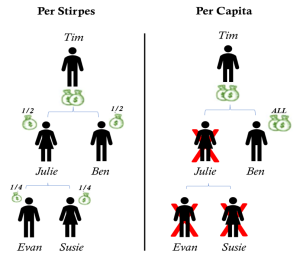
Choosing Per Stirpes, Tim’s IRA passed down through the family line to Julie’s children, Evan and Susie when Tim dies.
Choosing Per Capita, Tim’s IRA is passed to Ben and Julie’s children (Tim’s grandchildren) inherit nothing.
Choosing the Right Beneficiary Structure for Your Estate Plan
When filling out your beneficiary designation form, you will be asked to choose either Per Stirpes or Per Capital so it’s important to understand the difference.
The choice between per stirpes and per capita can significantly affect estate planning outcomes, especially in blended families or when beneficiaries have children of their own.
Per stirpes is often preferred when the goal is to keep inheritances within a beneficiary’s family line, while per capita is simpler and focuses only on living beneficiaries. Because IRA beneficiary designations override a will, it’s important to select the option that best reflects the account owner’s intent and overall estate plan.
This distinction is critical for IRA planning because beneficiary designations—not your will—control who ultimately receives your retirement accounts.
Special Considerations When Naming a Spouse as Beneficiary
Important Note: When naming a spouse as the primary beneficiary, you generally do not need to choose per stirpes or per capita for them. These designations define how a share passes if a beneficiary dies before you; if your spouse (the primary) passes away, the assets typically go to your listed contingent beneficiaries (e.g., children) instead.
If you would like to review the named beneficiaries on any of your accounts in greater detail, please get in touch with your ACM advisor.
Advisors Capital Management, LLC is an investment advisor registered with the United States Securities and Exchange Commission. Registration does not imply any degree of skill or training. All investing carries risk, including the potential for the loss of principal and past performance is no guarantee of future results. This content is for informational purposes only, can change at any time without notice, and is not investment advice or a recommendation to trade any security. Indices are not available for direct investment. We only provide services in jurisdictions where we are registered. Our disclosure brochure (ADV Part 2A) and customer relationship summary (ADV Part 3) are available at https://adviserinfo.sec.gov and upon request.


